
VO₂ Max: One of the Most Important Numbers for Living Better, Longer (Copy)
Why Your Fitness May Matter More Than Your Cholesterol
When most people think about their health, they think about weight, cholesterol, blood pressure, or blood sugar.
While those metrics matter, there is another measurement that may be even more important:
VO₂ max.
VO₂ max is one of the strongest predictors of longevity, cardiovascular health, physical independence, and overall healthspan that we can measure.
At Pillar Healthspan, we believe exercise is not simply a lifestyle recommendation—it is medicine. Understanding and improving your VO₂ max may be one of the most powerful interventions available to reduce your risk of heart disease, diabetes, dementia, frailty, and premature death.
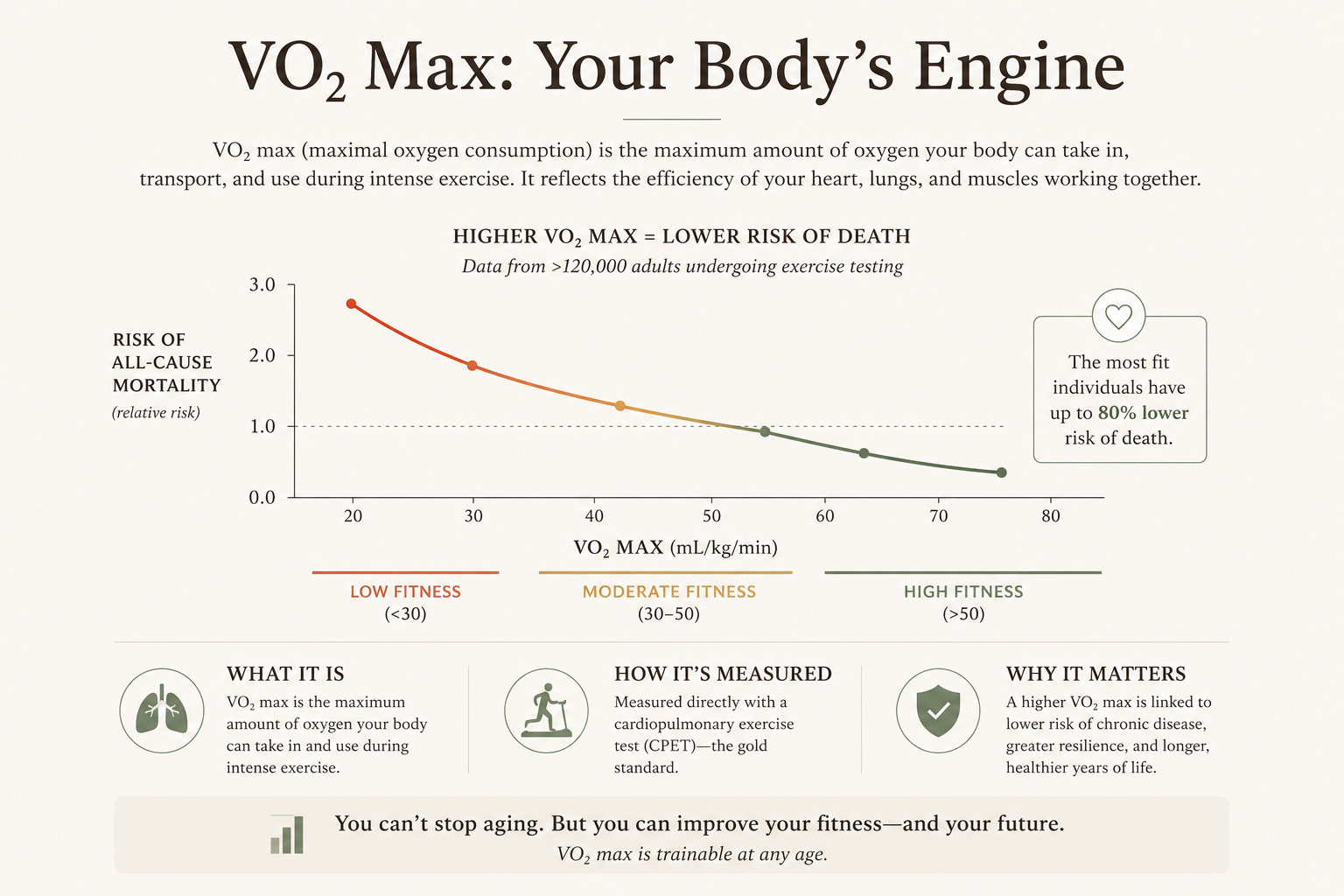
What Is VO₂ Max?
VO₂ max stands for maximal oxygen consumption.
It represents the maximum amount of oxygen your body can take in, transport, and utilize during intense exercise.
Simply put:
VO₂ max measures the combined performance of your lungs, heart, blood vessels, and muscles.
When you exercise, oxygen must travel through several steps:
Air enters your lungs.
Oxygen moves into your bloodstream.
Your heart pumps oxygen-rich blood to your muscles.
Your muscles extract and use that oxygen to produce energy.
VO₂ max reflects the efficiency of this entire system.
The higher your VO₂ max, the greater your body’s capacity to perform physical work and the larger your physiological reserve as you age.
Why VO₂ Max Matters for Longevity
Among all exercise-related metrics, VO₂ max has perhaps the strongest evidence linking it to longevity.
In a landmark study of more than 120,000 patients published in the Journal of the American Medical Association, researchers found that individuals with higher cardiorespiratory fitness had significantly lower mortality rates compared with those who were least fit.
Perhaps most strikingly, there was no apparent upper limit where increasing fitness became harmful. Elite-level fitness was associated with the lowest risk of death.
The authors concluded:
“Cardiorespiratory fitness is inversely associated with long-term mortality with no observed upper limit of benefit.”
The implications are profound.
A higher VO₂ max is associated with:
Lower all-cause mortality
Lower cardiovascular mortality
Reduced risk of coronary artery disease
Reduced risk of hypertension
Reduced risk of Type 2 diabetes
Lower incidence of dementia
Better physical function later in life
Greater independence and resilience with aging
In many studies, cardiorespiratory fitness predicts survival more strongly than obesity, hypertension, smoking status, or cholesterol levels.
VO₂ Max and Healthspan
Most people focus on lifespan.
At Pillar Healthspan, we focus on healthspan—the years of life spent healthy, capable, and independent.
Think of VO₂ max as your physiological reserve.
As we age, VO₂ max naturally declines approximately 5–10% per decade.
If you begin adulthood with a low VO₂ max, that decline may eventually bring you below the threshold needed for everyday activities such as:
Climbing stairs
Carrying groceries
Walking long distances
Playing with grandchildren
Recovering from illness or surgery
Individuals with higher fitness enter older age with a larger reserve, making them more resilient when life’s inevitable challenges occur.
How Is VO₂ Max Measured?
Gold Standard: Cardiopulmonary Exercise Testing (CPET)
The most accurate method is direct measurement during a graded exercise test.
The individual exercises on a treadmill or bicycle while wearing a mask that analyzes:
Oxygen consumption (VO₂)
Carbon dioxide production (VCO₂)
Ventilation
Heart rate response
This is the method used in research laboratories, elite athletic performance centers, and advanced healthspan programs.
At Pillar Healthspan, this type of testing provides objective information about cardiopulmonary fitness and allows us to track meaningful improvements over time.
Submaximal Testing
VO₂ max can also be estimated using:
Treadmill protocols
Cycle ergometer tests
Step tests
Rowing assessments
These methods are less precise but still provide useful information.
Wearables
Many smartwatches estimate VO₂ max using:
Heart rate
Pace
Speed
Elevation changes
Activity history
Devices from companies such as Apple, Garmin, and WHOOP can provide trend data.
While wearable estimates are not as accurate as direct testing, they can be useful for monitoring progress over time.
What Is a Good VO₂ Max?
VO₂ max varies by age and sex.
For men:
Age
Excellent
30-39
>52 ml/kg/min
40-49
>50 ml/kg/min
50-59
>45 ml/kg/min
60+
>40 ml/kg/min
For women:
Age
Excellent
30-39
>42 ml/kg/min
40-49
>39 ml/kg/min
50-59
>35 ml/kg/min
60+
>31 ml/kg/min
More important than any single number is understanding where you fall relative to your peers and whether your fitness is improving over time.
How Do We Improve VO₂ Max?
VO₂ max improves through exercise that challenges the cardiovascular system.
The most effective programs combine both moderate-intensity aerobic training and high-intensity interval training.
Zone 2 Training
Zone 2 refers to exercise performed at a sustainable intensity where conversation is possible but somewhat limited.
Examples include:
Brisk walking
Jogging
Cycling
Rowing
Swimming
Research demonstrates that Zone 2 training improves:
Mitochondrial density
Fat oxidation
Metabolic flexibility
Aerobic efficiency
For most adults:
Goal: 150–300 minutes per week
Examples:
30–45 minutes, 4–5 days per week
60 minutes, 3–4 days per week
High-Intensity Interval Training (HIIT)
HIIT appears to be one of the most powerful tools for improving VO₂ max.
A classic protocol includes:
4 x 4 Method
4 minutes hard effort
3 minutes recovery
Repeat 4 times
Research from Norwegian exercise physiologists has consistently shown significant improvements in VO₂ max using this approach.
For most healthy adults:
1–2 sessions per week is sufficient.
Resistance Training Matters Too
While resistance training does not improve VO₂ max as effectively as aerobic training, it remains essential for healthspan.
Strength training helps:
Preserve muscle mass
Improve insulin sensitivity
Reduce fall risk
Maintain bone density
Improve functional independence
The strongest healthspan strategy combines:
Zone 2 aerobic training
VO₂ max-focused intervals
Resistance training
The Exercise Prescription We Recommend
For many adults, an evidence-based weekly framework looks like:
Weekly Minimum
Zone 2
150–300 minutes
VO₂ Max Intervals
1–2 sessions
Strength Training
2–4 sessions
Daily Movement
7,000–10,000+ steps
This combination addresses nearly every major chronic disease pathway simultaneously.
The Bottom Line
If there were a medication capable of reducing cardiovascular disease, diabetes, dementia, frailty, disability, and premature death simultaneously, it would become one of the most prescribed therapies in medicine.
Exercise—and specifically improving cardiorespiratory fitness—already does exactly that.
VO₂ max is not simply a performance metric for athletes.
It is a measure of physiological resilience.
It reflects the capacity of your heart, lungs, blood vessels, and muscles to support the life you want to live.
At Pillar Healthspan, we view VO₂ max as one of the most actionable biomarkers of future health. Measuring it provides insight. Improving it provides opportunity.
The goal is not merely to live longer.
The goal is to remain capable, independent, and vibrant for as many years as possible.
Because longevity without vitality is not the outcome we are seeking.
It is healthspan that matters.
References
Mandsager K, Harb S, Cremer P, et al. Association of Cardiorespiratory Fitness With Long-term Mortality Among Adults Undergoing Exercise Treadmill Testing. JAMA Network Open. 2018;1(6):e183605.
Blair SN, Kohl HW III, Paffenbarger RS Jr, Clark DG, Cooper KH, Gibbons LW. Physical Fitness and All-Cause Mortality. JAMA. 1989;262(17):2395–2401.
Kodama S, Saito K, Tanaka S, et al. Cardiorespiratory Fitness as a Quantitative Predictor of All-Cause Mortality and Cardiovascular Events. JAMA. 2009;301(19):2024–2035.
Ross R, Blair SN, Arena R, et al. Importance of Assessing Cardiorespiratory Fitness in Clinical Practice. Circulation. 2016;134:e653-e699.
Strasser B, Burtscher M. Survival of the Fittest: VO₂max, a Key Predictor of Longevity? Frontiers in Bioscience. 2018;23:1505-1516.
American College of Sports Medicine. ACSM’s Guidelines for Exercise Testing and Prescription. 11th Edition.
Helgerud J, Høydal K, Wang E, et al. Aerobic High-Intensity Intervals Improve VO₂max More Than Moderate Training. Medicine & Science in Sports & Exercise. 2007;39(4):665–671.